VESTING DAILY
Good morning!
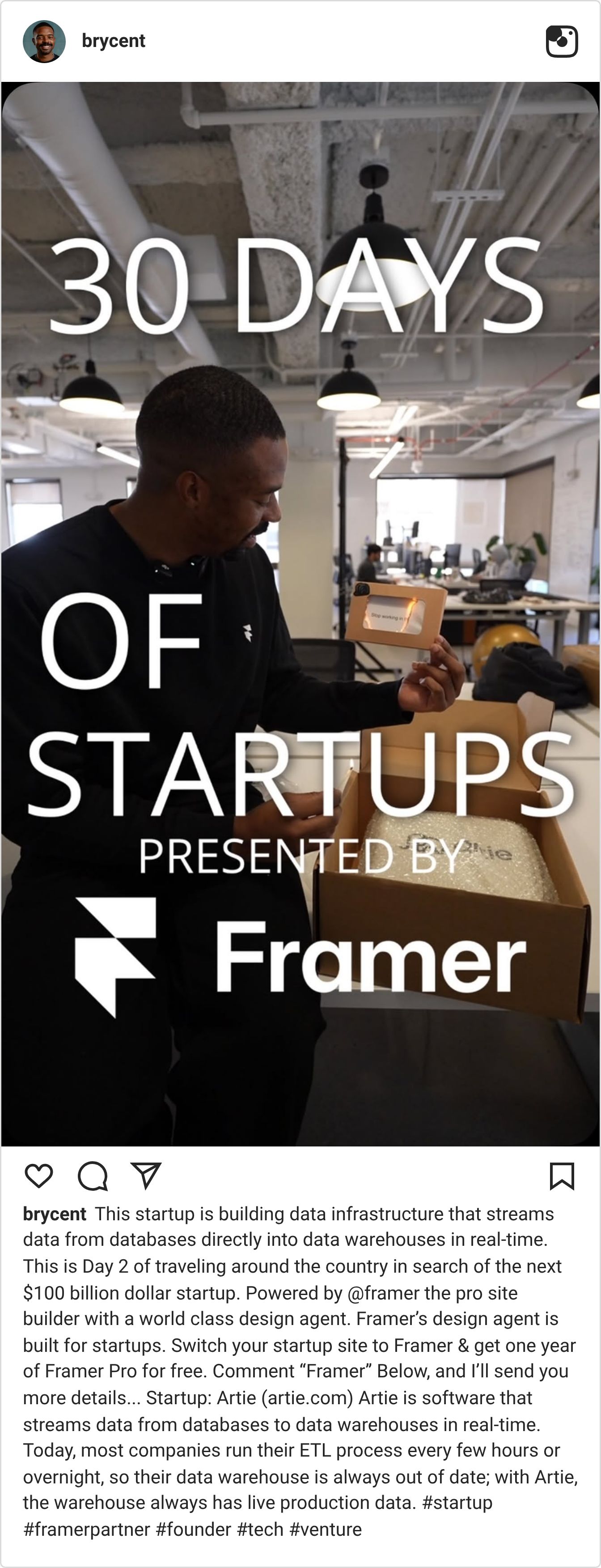
Day two of 30 Days of Startups is live. Every day this month we are touring a new startup and talking to the founders, hosted by our good friends at Framer. Catch today's episode here:
On the news side, one Chinese company took more than a quarter of the planet's venture money in October, Garry Tan told Walter Isaacson what his token bill looks like, and Anthropic put a sentence in its IPO filing that its lawyers must have read three times. Let's get into it.
The One Number
27 percent

That is how much of the planet’s venture money went to one company in October. Crunchbase’s October recap counts $59 billion raised globally, up 45 percent on last year, and $15.9 billion of it was DeepSeek’s round at a $90 billion valuation. We did the division so you do not have to: 27 percent of the global total, 57 percent of everything raised in the US ($28 billion), and 77 percent of China’s $20.6 billion. Pull that one round out and October was a $43 billion month, which is normal, and would not have made this section.
To be fair to the people writing the big checks, training a frontier model costs about what a mid-sized utility costs to build, Anthropic and OpenAI have both raised more than this, and DeepSeek has already shown it can get more out of a dollar than either of them. From where a sovereign fund or a late-stage crossover investor sits, $16 billion into the third most valuable lab on earth is a reasonable thing to do with the money. We do not think they are wrong about that.
What we keep coming back to is that venture totals are counted in dollars, not in deals, and that changes who the number is about. Seven rounds of $1 billion or more took a little over 40 percent of October. The report has no deal count and says plainly that seed figures keep getting revised upward for a quarter or more after the month closes, which means the part of the market you are in is the smallest piece of the pie and also the piece they measure last. A 45 percent jump can be true for the asset class and false for every room you will walk into this month.
So when someone tells you funding is up, the honest follow-up is: weighted by what. The chart your investor is looking at is weighted by DeepSeek. Your round will be priced against the last handful of seed deals in your category, and we could not find a single number in this report suggesting those moved. Pitch to that market, not to the headline.
It was a great October for about seven treasury departments.
The Fact Sheet
Tutor Intelligence ($75M Raised, Series B). Watertown, Massachusetts. Rents warehouse robots by the hour, with remote human "tutors" steering them until the models can do the work alone; the price list on its site runs $14 to $18 an hour with an 80 hour monthly minimum. Backed by Andreessen Horowitz and Union Square Ventures.
GIVA ($100M+ Raised). Bengaluru fine jewellery brand with more than 400 stores across India and Sri Lanka. Backed by Multiples Alternate Asset Management.
42AI ($62.5M Raised, Seed). Israeli model that predicts human behavior, out of stealth with a round raised over three years mostly from the founders and the chairman's family office, and deployed at about ten brokerages. Backed by Infinity Group.
Trajectory ($45M Raised, $300M Valuation, Series A). Lets a company take an open model, plug it into its own apps, and retrain it on feedback without a research team; Harvey, Rogo and Nvidia are already on it. Backed by Sequoia and Nvidia.
Lazarus AI ($43M Raised). Boston on-prem enterprise AI for document extraction, code vulnerability finding and mainframe modernization, with no per-token pricing. Backed by QBE Ventures and State Farm Ventures.
Corridian ($38M Raised, Seed). Boston team from General Dynamics' undersea autonomy group building uncrewed submarines that carry shipping containers thousands of miles; the first vehicle is due in 2027. Backed by Point72 Ventures and DCVC.
Guava ($12.5M Raised, Seed). Los Angeles developer platform for voice agents with its own speech recognition, language and text-to-speech models, run by Marqeta's former chief revenue officer. Backed by Acrew Capital.
Journify ($12M Raised, Series A). San Francisco ad signal infrastructure that cleans conversion data and ships it to Google, Meta and TikTok; the round came at four times the last valuation. Backed by Al Mada Ventures and Silicon Badia.
SYNCERE ($11M Raised, Pre-Seed). Palo Alto maker of LUME, a $2,699 floor lamp with robotic arms that folds laundry and makes beds. Backed by a16z Speedrun and Draper Associates.
Archiboost AI ($6.2M Raised, Pre-Seed and Seed, announced together). San Francisco AI that checks architecture and construction drawings for errors; 550,000 sheets reviewed so far across $3.5 billion of projects. Backed by Hanabi Capital and Marathon Venture Capital.
Athena ($2.5M Raised, Pre-Seed). San Francisco AI legal services firm charging a fixed fee per property deal, built as two entities so the lawyers own the law firm and the investors own the software. Backed by a16z Speedrun.
Also raised: PowerUp Money $10M (Flourish Ventures, India), Quint Computing €9.1M (Vsquared, Germany), OSSTEC $8M (EMBRYO Ventures, London), Vitroscope $7M including a $2M grant (Cerberus Ventures and YZR Capital, Norway), Tumbleweed €6.9M (PactVC, Austria), Conlio €6.4M (Piton Capital), CyberKord €2.7M, Virdi €2.6M (Southampton), 1nhaler £2.2M (Scotland), Granter €1.6M (Portugal), The Croffle Guys ₹14 Cr (India), Solgram $1M+ (India).
Headlines, No Fluff
→ Garry Tan spends up to $200,000 a year on AI tokens, and he says that is the part most people cannot copy. The YC president told Walter Isaacson his personal token bill runs $100,000 to $200,000 a year, which at the top end is $548 a day, more than most seed founders pay themselves. His agent has read all of his email, his Dropbox and his Apple Notes, including 20 years of therapy notes. YC's internal agent, Stray Light, holds every application the accelerator has ever received. Tan called the spending "a crazy privilege that not everyone can do." The privilege is the product.
→ Squarespace cut 19 percent of its staff two years after a $7 billion buyout, and the article's own URL says $6.6 billion. About 300 people are going, which puts the pre-cut headcount near 1,580. The company said it is "restructuring its organization" to "sharpen our priorities," and did not name departments. The competition it is sharpening against raised more than it did: Lovable took $400 million at $13.3 billion in August, and Wix bought Base44 for $80 million. Squarespace spent two decades selling a website for people who could not code. Lovable sells the same thing to people who still cannot.
→ Anthropic's IPO filing says it may "imminently" cross its own line for AI building AI, and that it missed that line once before. The revised S-1 filed Monday says internal estimates "indicate that we may imminently meet" the Responsible Scaling Policy's definition of "dramatically accelerated progress attributable to AI," and that in the past the company "has not identified" such acceleration until after it happened. No current model is over the threshold, and Anthropic says it will not let Claude build successive frontier generations without human oversight. An S-1 is also a sales document, and this one is selling a company that may be about to trip its own alarm. The risk factor is the pitch.
→ Oracle set a $20 billion borrowing cap a week ago, and used all of it on Monday. The cap was supposed to last through fiscal 2030. Instead Oracle priced $10 billion of stock at $116, 11.2 percent under Friday's close, and $10 billion of bonds with coupons from 7 to 8.65 percent, and the shares fell 8.8 percent. Capex goes from $55.7 billion last year to a planned $90 to $95 billion this year, and $300 billion of its $455 billion in contracted revenue is OpenAI. CFO Hilary Maxson called the cap "a real commitment." It lasted seven days.
→ A $17 million fund just launched to back European startups, and most of what it has bought so far lives in the United States. Yvonne Bajela, formerly of LocalGlobe and Phoenix Court, closed Evertrue Capital's first fund at $17 million against a target of about $13 million. It has already backed seven companies at roughly £350,000 a check and plans at least twenty over three years, with the British Business Bank and Phoenix Court's fund of funds as anchor LPs. TechCrunch notes more than half the portfolio operates in the US. The fund is in dollars, the checks are in pounds, and the companies are in neither.
On Vesting
Open Doors
Fresh:
Techstars NYC, Spring 2027: final deadline Nov 18. $220,000 in total: a $200,000 uncapped SAFE plus $20,000 for 5 percent. Starts March 8. Apply
Y Combinator Winter 2027: the on-time deadline was Nov 2 at 8pm PT, and the page says late applications are still being accepted, so this week is the window. Batch runs January to March in SF. Apply
a16z Speedrun: SR008 closed Nov 1; new applications roll into the next residency. Up to $1 million per company. Apply
Still open:
Always rolling: Z Fellows reviews on a rolling basis with no deadline, $10,000 at a $1 billion cap. Apply
🤝 How Vesting Can Help You
We read everything so you do not have to, and some of what we read should be about you. If you are a founder with a launch or a raise, a fund with a thesis, or a company that wants to be in front of 20-something operators before they are famous, reply to this email.
Till next time,
The Vesting Team (Brycent, Ajay, and Kamil)