VESTING DAILY
Good morning.
OpenAI told Cursor on Friday night that it has until November 12, and the clause it used had nothing to do with anything Cursor did. Sony and Warner filed against Anthropic a few hours earlier and named the founders personally. And a former Instagram engineer's Series A became public nine months after it closed because a reporter read a filing. Let's get into it.
Let's get into it.
The One Number
76

That is how many days of notice OpenAI gave Cursor on Friday, and it is not a courtesy. OpenAI told SpaceX it intends to stop providing its models to Cursor on November 12, and said in the same post that it is giving the maximum notice the contract allows. So 76 days was the ceiling, not the floor.
Work out what that buys. The two companies have worked together for nearly four years, call it 1,430 days. The wind-down window is about 5 percent of the relationship. A company can lose the supplier its entire product depends on in less time than most enterprises take to approve a new vendor.
The clause is the part worth learning. OpenAI says its custom agreement with Cursor "gives us a limited time window to cancel it after a change of control." Cursor did not breach anything. It did not miss a payment, leak a weight or violate a term. It got acquired by SpaceX, and the acquisition itself is what opened the window. openai
The steelman is strong and OpenAI makes it in public. It says it cannot be confident SpaceX will stay inside the terms, and it points at the record: Twitter breaking its OpenAI contract after Musk bought it, and Musk conceding under oath this year that xAI had violated those same terms. A supplier is allowed to decline to arm a competitor's parent company. Most would.
For founders the lesson is narrower and more useful than "platform risk is real." A change-of-control provision in a supply agreement is an asset your acquirer is buying and a trigger your acquirer pulls by buying you. When SpaceX ran diligence on Cursor, that clause was in the data room. Somebody priced it or somebody did not, and either way the model access was never fully Cursor's to sell. If your company's value rests on an API you rent, go read what happens to that contract the day someone writes you a check.
This is also why the hedging is happening. Nvidia is reportedly paying $13 billion for Hugging Face, Stripe paid north of $7 billion for OpenRouter, and Nvidia put $6 billion into Poolside, all inside a few weeks. Twenty six billion dollars is a lot to spend on models you give away, until Friday, when it became the price of not needing anyone's permission.
OpenAI added that it will not provide Cursor with its future models. Cursor has 76 days of access to what exists and none to what comes next.
The Fact Sheet
Retro ($21M Raised, Series A). Photo-sharing app from two former Instagram product engineers who worked on Stories, built for small groups of friends rather than feeds, with no advertising and a subscription instead. Around 7 million downloads and in-app spending up more than 460% over the past 180 days, per Appfigures. Backed by Thrive Capital and Figma's Dylan Field.
Headlines, No Fluff
Sony Music Publishing and Warner Chappell filed in the Northern District of California, listing Dario Amodei and Benjamin Mann as individual defendants and alleging a "brazen campaign of illegally torrenting, scraping, and downloading copyrighted works." All three major publishers are now suing the same company. The complaint covers tens of thousands of compositions where BMG's covered 493, and asks for up to $150,000 per work plus $25,000 for each stripping of copyright information. The number that matters is not the ask. Anthropic already paid $1.5 billion to settle the authors' case, and the publishers cite that settlement in their own filing as proof the price was "not large enough to deter infringing conduct." Anthropic says it disagrees and will defend itself. Forty eight pages, filed after the market closed on a Friday.
Friday's tranche was a billion dollars of private, short-dated debt arranged by JP Morgan Chase, against Nvidia chips that Lambda will lease to Microsoft. Before that came a billion dollar secured credit facility in May and a $926 million term loan B this week, the latter funding GB300s for a deployment Lambda is already contracted to provide to Nvidia. It is also in talks for three billion of equity ahead of an IPO. The company was last priced at $5.43 billion post-money in November. Short-dated debt is a bet that the chips start earning before the note comes due, which is a different kind of confidence than a Series D. Bloomberg counts more than four hundred billion dollars of AI-related debt raised globally this year, which works out to about one and a half billion a day since January.
Andreessen Horowitz spent its first five years avoiding healthcare, then handed the category to a Stanford chemistry professor who had built Folding@home. He grew it to nearly four billion dollars and left in June of last year. His new firm, VZVC, is two people on the investment side, no associates, and roughly five concentrated bets a year. He had planned to hire associates and then found the agents his team built made the hires unnecessary. His line on the old model is that adding a portfolio company at a normal fund is like adding a friend on Facebook, something you do quickly and then mostly forget. He is describing the business that most of his former colleagues still run.
Agnes Kim spent eight years at Xbox and could see what was coming, so she started building at night. ViaJiin, a boutique Korean skincare company sourcing from a home market with more than thirty thousand brands, was incorporated in March and running focus groups by May, all while she held a full-time executive role. Microsoft cut 1,600 Xbox jobs in July. Kim announced the new company on LinkedIn two days after her notice arrived. Everyone in tech now says they are working on something on the side. This is what it looks like when someone means it.
On Vesting
Open Doors
Fresh:
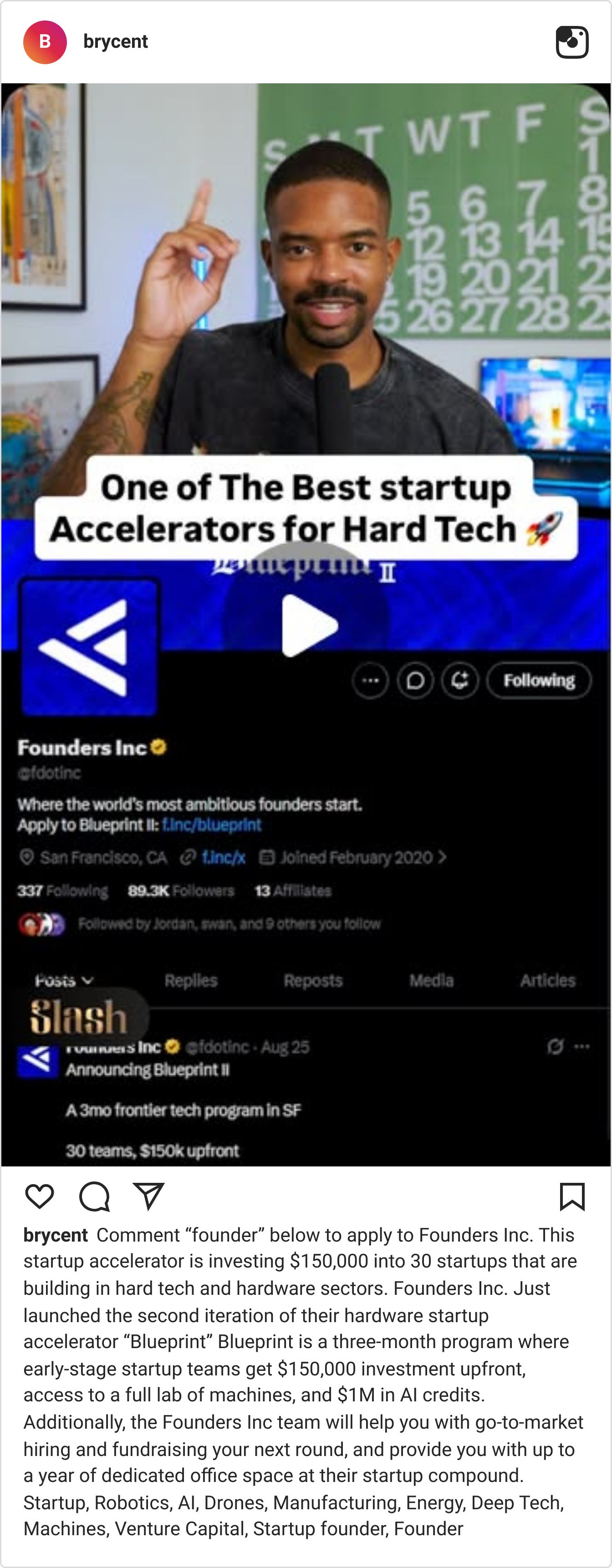
Techstars, Spring 2027. Sixteen accelerators opened applications last Monday. Final deadline November 18, programs start March 8, Demo Day June 3.
NIH Parent SBIR, PA-27-100. Next standard receipt date is September 5, which is Saturday. Non-dilutive, and the review cycle is long enough that missing it costs you four months.
NSF SBIR Phase I. Up to $305,000, no equity. Next deadline November 4.
Still open:
Y Combinator, Fall 2026. The on-time deadline was July 27 and the page still says late applications are being accepted. No stated decision timing for late submissions.
a16z Speedrun. Up to $1 million. SR008 priority review runs October 12 to November 1, applications accepted year round.
Always rolling: Z Fellows gives you $10,000 and a week with founders of billion dollar companies, as a grant or as an investment at a $1 billion cap. No deadline.
🤝 How Vesting Can Help You
Cursor's most valuable asset had a clause in it that let somebody else take it away, and the trigger was getting bought. Retro's round closed in December and nobody knew until a reporter opened an SEC filing. Both of those are documents doing something the pitch deck never mentions.
Send us the supplier agreement you have not read since you signed it and we will tell you what your acquirer sees in it. Or put the whole company in front of the list instead: Get Featured.
Till next time,
The Vesting Team (Brycent, Ajay, and Kamil)